
Scooter Delivery Is Quietly One of the Best Gigs in Busy Metros Right Now
Driver Reporting · Busy Metros
Scooter Delivery Is Quietly One of the Best Gigs in Busy Metros Right Now
I've been talking to scooter couriers working DoorDash, Uber Eats, and Grubhub in dense cities — starting with drivers in Los Angeles. Here's what they're actually earning, and why the math works in any metro with traffic, tight parking, and short delivery radii.
I keep hearing the same thing from delivery drivers in Los Angeles: ditch the car, grab an electric scooter, and watch your numbers change. Multiple scooter couriers I've talked to in the LA area say they're pulling in upwards of $300 a day and knocking out 30+ orders in a single shift. No gas station stops. No parking tickets. No circling a block for ten minutes because every spot near the restaurant is taken.
And LA isn't a special case — it's just an early, visible example of something that plays out the same way in any dense metro. Gas prices nationally are sitting around $4.10 a gallon right now, sharply up from about $3.15 a year ago (though still short of the all-time record near $5.02 set in 2022). A car-based Dasher or Uber Eats driver in Chicago, Miami, Boston, or anywhere with real traffic and real parking pressure is bleeding money into a tank before they've made a dollar. A scooter courier's "fuel cost" is a wall outlet and a few cents of electricity — in any city.
So I wanted to break down what's actually going on here — why dense, traffic-heavy metros are such fertile ground for scooter delivery, which platforms let you do it, what the real trade-offs are, and why this same setup could get you deactivated or fined in a city like New York.
Why Scooter Drivers Are Outrunning Car Drivers in Busy Cities
The pattern LA drivers describe holds up in any dense metro — Chicago's Loop, Boston's narrow streets, Miami's beach-adjacent traffic, Austin's downtown core. A few things stack in a scooter courier's favor:
- Cutting through traffic. A scooter can use bike lanes, alleys, and shortcuts that leave a car driver sitting dead still during a lunch or dinner rush — whether that's Sunset Blvd in LA or Michigan Ave in Chicago.
- No parking problem. Pulling up to a restaurant on a scooter means walking straight in. A car driver is hunting for a spot, or double-parking and risking a ticket — both of which eat minutes that could be another order, and parking is tight in nearly every dense downtown core.
- Lower overhead, full stop. No gas, lower insurance costs, no oil changes, no car payment tied to the gig. A used electric scooter capable of delivery work runs a fraction of what a reliable delivery car costs.
- Dense delivery zones. Any metro with a compact downtown, urban neighborhood grid, or college-town core — think LA's Koreatown and DTLA, or similar dense pockets in Chicago, Philly, or Denver — packs more orders into a smaller radius. That's exactly the environment where a scooter's maneuverability turns into more completed orders per hour.
Thirty-plus orders and $300 in a day isn't guaranteed for everyone, and it's a number reported specifically by LA drivers — it depends on the zone, the hours worked, and how aggressively someone stacks orders across multiple apps. But the underlying mechanics (lower cost per mile, faster maneuvering, no parking delays) apply just as much in Chicago or Denver as they do in LA — the exact daily number will shift with local order density and pay rates.
Which Platforms Actually Let You Deliver on a Scooter
Not every app treats scooters the same way. Here's where things stand:
- DoorDash — Scooter is a listed, supported vehicle type alongside car and bike. You'll need a smartphone and an insulated bag; no license or insurance requirement tied to scooter use specifically.
- Uber Eats — Also lists scooter as an accepted vehicle type, and in some cities you can even deliver on foot. Uber Eats tends to be one of the more flexible platforms for non-car delivery.
- Grubhub — Scooter and bike delivery are supported in select urban markets, alongside car and motorcycle. Worth checking availability in your specific zone before counting on it.
- Courial — A smaller courier platform, but notable because it's built for exactly this: car, bike, scooter, or walking delivery, and it's known for actively supporting electric-vehicle couriers with added benefits. Available in select cities including LA.
The takeaway: if you're running DoorDash, Uber Eats, and Grubhub simultaneously on a scooter in a dense zone, you're not limited to one app's order flow — you're stacking whichever platform pings first, which is a big part of how drivers get to 30+ orders in a day.
What LA scooter couriers are actually riding
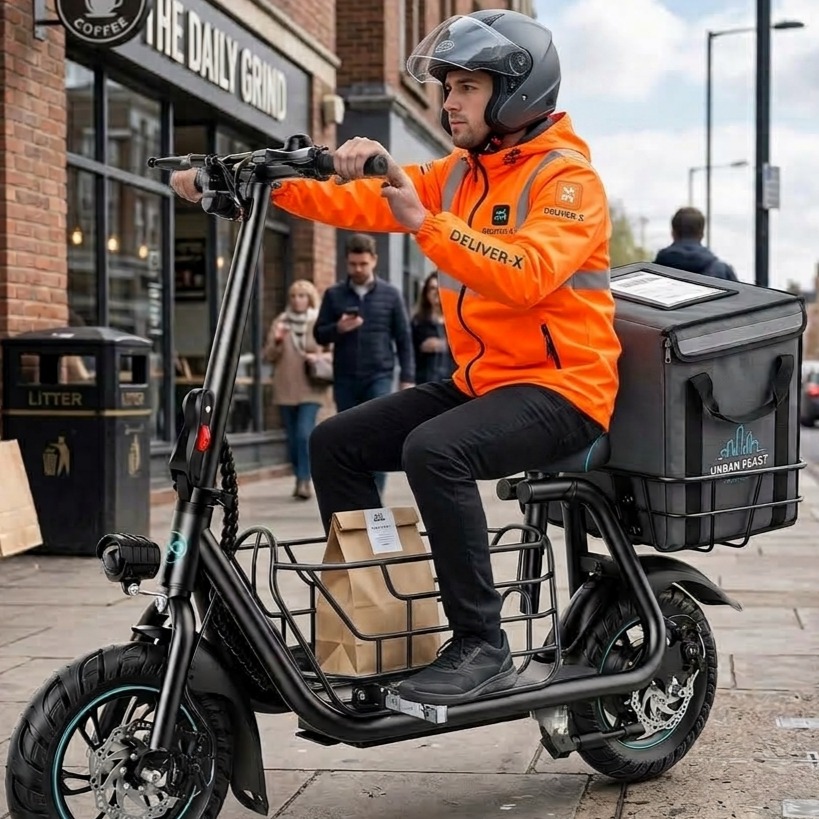
I put together a running list of the scooters and delivery setups drivers have pointed me to — including foldable models built for exactly this kind of multi-stop, all-day work.
Shop the gearA scooter built for the job
Gyroor Electric Scooter with Seat for Adults
- 20-mile range on a charge
- 550W motor, up to 18.6 MPH
- Foldable design for apartment or trunk storage between shifts
- Built-in rear cargo basket — enough room for a bag or small order stack
- 12" tires for a smoother ride over rough streets
- 4.3★ (657 ratings) · Amazon's Choice
The Trade-Offs Nobody Skips Mentioning
This isn't a "quit your car and get rich" pitch. The drivers who make scooter delivery work are managing real trade-offs:
- Order size limits. A scooter isn't hauling a Costco-sized Instacart order or a stack of catering trays. This model works for food delivery — smaller, faster orders — not grocery or bulk delivery.
- Weather and climate. No windshield, no AC, no heater. This model works close to year-round in warmer, drier metros like LA or Austin, but it's a much tougher call through a Chicago winter or a Miami downpour — cold, snow, and heavy rain cut directly into what a scooter courier can safely ride.
- Physical wear. Hours on a scooter is a different kind of tired than hours in a car seat. Drivers mention needing better gear — proper footwear, weatherproof layers, a real phone mount — to make full shifts sustainable.
- Theft and battery upkeep. A scooter left outside a restaurant is a target in any city. A solid lock and a charging routine become part of the job, not an afterthought.
Why the Rules Change Completely From City to City
It's worth being clear-eyed here: what's working for scooter couriers in LA right now would run into serious friction in New York City. In 2026, NYC rolled out its strictest e-bike and scooter rules yet — a citywide 15 mph speed limit, mandatory UL-certified batteries for every app-based delivery worker under Local Law 95, and a new mandatory DOT safety training. Non-compliant equipment in NYC isn't just a ticket anymore — it can mean impoundment, a battery seized by the FDNY, or getting deactivated by the very app you depend on.
California has its own tightening rules too — a 2026 state law requires certified batteries and mandatory reflective lighting on e-bikes at all hours — but LA hasn't layered on the kind of delivery-specific licensing and enforcement NYC has. There's one licensing wrinkle worth knowing, though: unlike e-bikes, which require no license in California regardless of class, e-scooters legally require a valid driver's license or learner's permit to operate (CVC §21235(d)). It's not a special or commercial license — just a standard one — but it's a real requirement scooter couriers need and e-bike riders don't.
Other states are moving in different directions entirely: New Jersey now classifies e-bikes as motorized vehicles requiring registration, insurance, and a driver's license, while most states still treat a compliant e-bike or scooter like an ordinary bicycle. That patchwork means the setup that works in one metro can be flatly illegal — or just far more regulated — an hour down the interstate.
Bottom line for any city: battery certification and speed-class rules are tightening almost everywhere in 2026, not just in NYC. Before you invest in a scooter for delivery, check your own city and state's current e-bike/scooter classification rules — what's loosely enforced today can tighten within a single legislative session.
Ride compliant, wherever you are
A certified battery and a real lock aren't optional anymore in most cities. Here's what I'd actually put on a delivery scooter before your first shift.
See the listBottom Line
If you're gig delivering in a dense, traffic-heavy metro and you're still car-dependent, the drivers I've talked to in LA make a compelling case for at least testing a scooter setup on the side. Lower overhead, faster maneuvering through traffic and parking, and the flexibility to stack DoorDash, Uber Eats, and Grubhub orders on one device adds up to real money — $300 days and 30+ orders are what disciplined LA scooter couriers are reporting right now, and the same underlying math applies anywhere with similar density, even if the exact numbers shift city to city.
Just go in with eyes open: buy a legitimate, certified battery, invest in a real lock, dress for the miles, and keep tabs on how your city's e-bike and scooter laws are shifting — because in this gig, the rules under your wheels can change faster than the apps do.
This post contains affiliate links. If you buy through them, GigWorldToday may earn a commission at no extra cost to you.
Thinking about making the switch?
Check out the scooters, locks, and cold-weather gear LA couriers are actually using before you buy.
Shop the delivery gear listWant More Weekly Operator Tips?
Get strategies to boost earnings delivered to your inbox.