
DoorDash's New Rewards Program: Is it an Upgrade or Not?
DoorDash is rolling out a new Dasher Rewards program in select cities and calling it an upgrade. There are three tiers now — Silver, Gold, and Platinum — based on a composite "Overall Dasher Rating" that combines six different metrics into one score. Check your Ratings tab or email to see if it's live in your market yet.
I've gone through the documentation. I've looked at what earns points and what doesn't. And I want to be direct with you: this system is not built for drivers. It's built to increase order acceptance rates and delivery speed. The rewards are real, but the cost of earning them tells you exactly what DoorDash actually values.
What the Tiers Look Like
Your Overall Dasher Rating is a point score built from six metrics: acceptance rate, completion rate, on-time rate, quality rate, customer rating, and last 30-day order volume. Hit the thresholds and you land in a tier:
- Priority for high-paying offers
- Early scheduling access
- Increased priority for high-paying offers
- Pause offers from 1 store
- + All Silver rewards
- Dash Now access
- Top priority for high-paying offers
- Large Order priority
- Pause up to 3 stores
- VIP Dasher Support
- Platinum Pass + discounts
Platinum is the only tier worth having. And that's by design.
The Acceptance Rate Problem
Let me tell you what they changed and what they didn't. Under the old Top Dasher system, you needed a 70% acceptance rate. This was actually achievable, because you could still decline the really bad orders while still maintaining a 70% acceptance rate.
The new system says there's no minimum acceptance rate. DoorDash is celebrating that — not drivers. This isn't a concession to drivers, it's a strategic move. By removing the hard floor, DoorDash gets to market this as "more flexibility" while quietly making acceptance rate the second most heavily weighted metric in the entire composite score, right behind on-time rate.
Think about that. Out of six metrics — customer rating, completion rate, quality rate, order volume, on-time rate, and acceptance rate — the two that matter most are the two that directly serve DoorDash's operational goals: move fast and say yes to everything. Your actual service quality as a driver is an afterthought in their scoring model. The "no minimum" language is cover. The weighting tells you the real story.
If you want Platinum, you need 85+ points. That means your acceptance rate has to be healthy. Which means you're still being pushed toward taking orders you'd otherwise decline. They just made it feel like your choice.
The On-Time Rate Is the One That Really Gets Me
Your on-time rate is the most weighted of all of the metrics — a whopping 40 points. It measures whether you complete deliveries by the estimated time DoorDash shows you when you accept an offer. Sounds fair. In practice, it's not — especially if you're dashing in a major metro.
DoorDash uses Google Maps' navigation and real-time traffic estimates to calculate your delivery time — and we all know that can change in an instant, but the delivery time in the app doesn't change with it. What Google Maps said was a 10-minute drive when you hit navigate becomes a 22-minute drive the moment you run into a double-parked truck on a one-way street, or a light that just changed. The clock doesn't care. Your on-time rate takes the hit anyway.
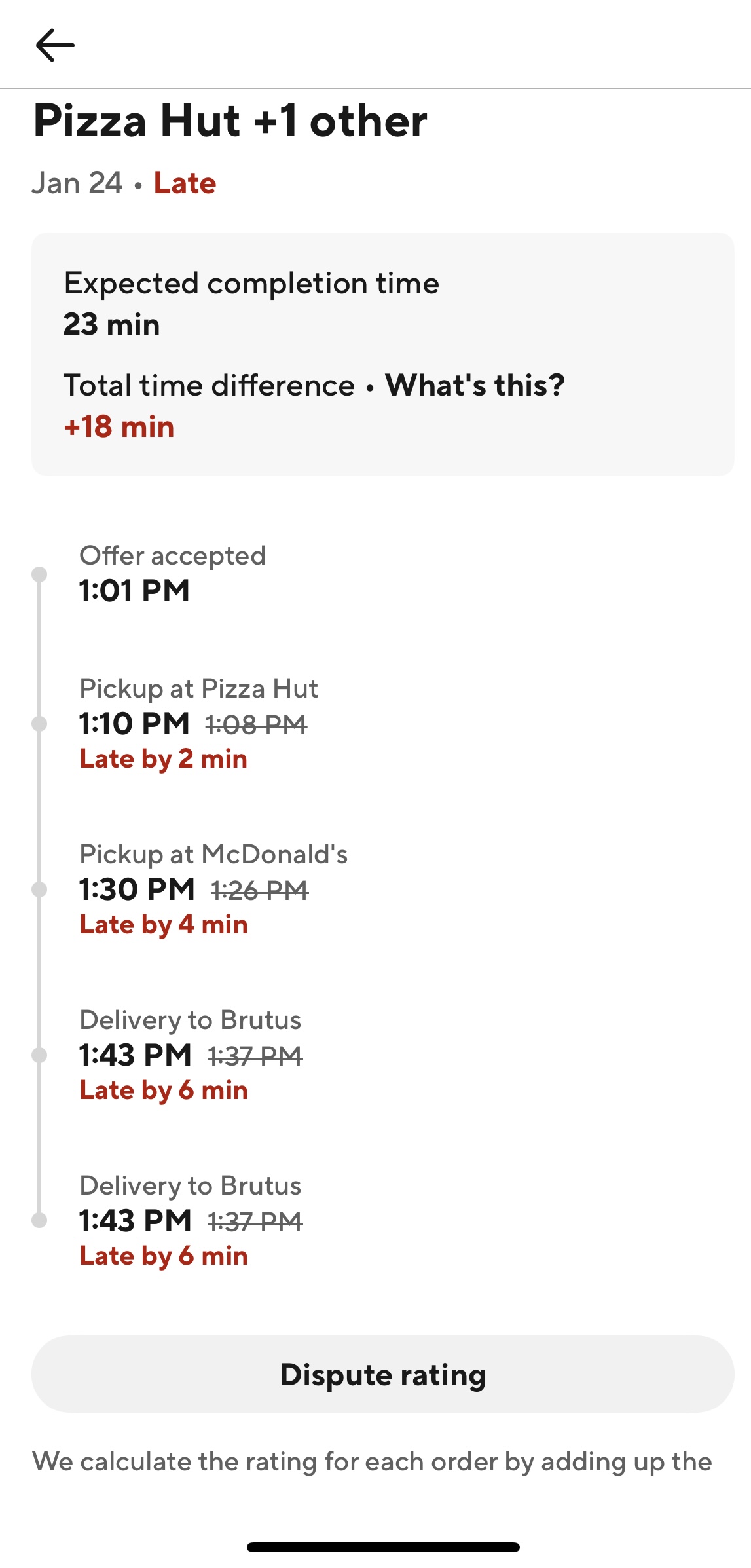
And the system is not forgiving. Look at this real example from inside the app: the driver was just 2 minutes late to the Pizza Hut pickup. That's it — 2 minutes. But because this was a stacked order with a second pickup at McDonald's, that 2-minute delay snowballed into a total of 18 minutes late by the time both deliveries were completed. One small hiccup at the restaurant and the entire order chain is flagged. That's not a driver failure. That's a batching problem that DoorDash created — and the driver's on-time rate pays for it.
Look at which cities this will hit hardest: Los Angeles. New York. Seattle. Chicago. These are the exact markets that have passed minimum pay ordinances and mileage-based compensation laws for gig workers — cities where legislation has forced DoorDash to pay drivers more. And now there's a scoring metric that penalizes drivers in those same cities for "late" deliveries based on time windows that don't reflect actual metro conditions. I'll let you draw your own conclusions.
What Actually Matters in This System
When you look at which metrics carry the most weight in the composite score, the message is clear: DoorDash values how much you work and how fast you move over how well you actually serve customers.
Your customer rating — the metric that most directly reflects your quality as a driver — has less composite impact than your acceptance rate and order volume. The quality rate, which tracks delivery accuracy with verified customer reports and is honestly the fairest metric in this entire system, is still in pilot and not fully rolled out. Meanwhile acceptance rate and last 30-day orders — both volume metrics — are fully live and fully weighted.
They built a reward system that rewards DoorDash's priorities, not yours.
The One Thing I'll Give Them Credit For
The store pause feature is actually useful. Gold Dashers can block one restaurant from sending you offers; Platinum can block three — for up to two weeks, without it affecting your acceptance or completion rate. Every driver has a mental blacklist of restaurants with chronic wait times. This finally gives you an official way to act on it.
The other genuine positive with this new system is transparency. DoorDash is now showing you exactly which orders are affecting your metrics. You can see a list of your last 100 orders, which ones counted against you, and why — like the Pizza Hut example above where you can see the exact timestamp breakdown of where the delay happened. Under the old system you were largely flying blind. Now at least you can see what's hitting your score and make a decision about whether to dispute it. That's a real improvement, and credit where it's due.
How to Protect Your On-Time Rate
The system may not be perfectly fair, but there are things you can control. Here's what actually moves the needle:
- Head to the restaurant immediately after accepting. Don't sit, don't check your phone — go. Every minute you delay at the start compounds at the end.
- Mark yourself arrived as soon as the app allows it. This is important — once you're marked arrived, if the restaurant is running late, you are not penalized for the wait time. That clock stops for you.
- Don't hit "Picked Up" until the order is physically in your hand. Not when you're walking to the counter, not when they're bagging it — when it's in your hand and you're ready to walk out the door.
- If you're multi-apping, be disciplined about it. Only accept a second order if you're confident you can complete both drop-offs within your given timeframes. One bad judgment call turns into two late marks.
- Dispute lates that are genuinely out of your control. DoorDash does have a dispute process built into the app. Use it. If you ran 15 minutes behind due to traffic or other factors out of your control, dispute the late. It won't always work but it costs you nothing to try.
Important: These metrics only apply to delivery-only orders. If you do Shop & Deliver orders, those are not counted toward your on-time rate or quality rate. If your metrics are struggling, leaning into Shop & Deliver while you rebuild is a legitimate strategy.
If you're full-time, high-volume, and willing to play by DoorDash's rules, Platinum is achievable and the benefits are worth having. Dash Now access alone changes how you structure your day.
If you drive in a major metro or drive part-time — understand that this system was not designed with you in mind. If you are selective about the orders you accept this system was designed with you in mind. Platinum will be difficult by design. The on-time metric will be harder for you than for someone dashing in a mid-sized market with light traffic.
Know the game before you play it. And if you feel like the rules aren't fair, you're not wrong.
Want More Weekly Operator Tips?
Get strategies to boost earnings delivered to your inbox.